Find by symptomHP-02
Brown Leaf Tips on Houseplants | Find the Cause from How the Brown Appears, Prevent It by Plant, and Trim Dead Tips
You can narrow down why houseplant leaf tips turn brown by which leaves brown and how. In winter, suspect dry air first; if it happens all year, suspect water and fertilizer.

In this article (15 sections)
- Conclusion: How Do You Tell Why Houseplant Leaf Tips Turn Brown?
- How Do You Find the Cause from a Houseplant's Leaf Symptoms?
- Why Do Houseplant Leaves Die Back from the Tips?
- When Does Dry Air Make Houseplant Leaf Tips Turn Brown?
- Can Misting Prevent Brown Leaf Tips on Houseplants?
- When Do Underwatering or a Rootbound Pot Make Houseplant Leaf Tips Brown?
- When Do Fertilizer Salts Make Houseplant Leaf Tips Brown?
- Do Old and New Leaves Brown at the Tips for Different Reasons?
- Can Tap Water Make Houseplant Leaf Tips Brown?
- Are Some Plants More Prone to Brown Leaf Tips?
- How Do You Trim Dead Houseplant Leaf Tips?
- How Do You Prevent Brown Leaf Tips on Houseplants?
- What Terms Come Up with Brown Houseplant Leaf Tips?
Frequently Asked Questions About Brown Houseplant Leaf Tips5
- Sources
Conclusion: How Do You Tell Why Houseplant Leaf Tips Turn Brown?
You can tell why houseplant leaf tips turn brown by which leaves are affected and how the brown appears. Tips of many leaves point to air and water, and tips of new leaves point to roots and nutrients.
In general, the causes fall into six groups. U.S. university advice services and garden manufacturer materials list almost the same ones.
- Dry air
- Underwatering
- Fertilizer salts (fertilizer components left behind and hardened in the soil)
- Substances in tap water or potting soil (fluoride, chlorine)
- Being rootbound
- Drafts from air conditioners or heaters
The trouble is that they all look the same: "brown leaf tips." Here is the key. Look at which leaves turn brown and in what pattern, and you can narrow down the six.
| How the brown appears | Cause to suspect first | What to check first |
|---|---|---|
| Tips of many leaves brown a little at a time, more so in winter | Dry air, drafts from AC or heaters | Whether the spot gets a draft. Room humidity |
| Leaf tips are brown and the plant is also wilting | Underwatering, rootbound | How dry the soil is, by finger. Whether roots come out of the bottom of the pot |
| Tips and edges are brown, with a white crust on the soil surface | Fertilizer salts | How often and how strongly you fertilize |
| On dracaena and similar plants, it continues even after changing care | Fluoride or chlorine in water or potting soil | Type of water. What is in the fertilizer and soil |
| The middle of the leaf is brown, not the tip | Overwatering | Whether the soil has stayed wet for days |
| Tips of new leaves die back | Shortage of calcium or other nutrients, root damage | Root color and firmness |
Yellowing leaves are covered in why houseplant leaves turn yellow. This article focuses on leaf tips and edges that turn brown and die.
How Do You Find the Cause from a Houseplant's Leaf Symptoms?
| Symptom | Likely causes | What to try first |
|---|---|---|
| Lower leaves turn yellow | Overwatering, root-bound pot, natural ageing | Check if the soil is wet deep down; look for roots at the drainage hole Read |
| Only the tips turn brown | Dry air or soil, too much fertilizer | Move away from air-con drafts; pause feeding Read |
| Leaves drop suddenly | Relocation shock, cold, underwatering | Did you move it? Check night temperatures |
| Black spots on leaves | Leaf spot disease, water splash, sunburn | Watch whether spots spread; keep leaves dry |
| Wilting although soil is wet | Root rot | Unpot and check root colour and smell Read |
The second row of the table is the symptom this article covers. If yellowing, leaf drop, or spots appear along with it, also see the article in that row.
If only the leaf tips are brown, the shortcut is to check "placement" and "water" before the roots. You can check both today without any tools.
Why Do Houseplant Leaves Die Back from the Tips?
Because the roots cannot keep up with the water leaving the leaves. When the supply falls short, the leaf edges and tips turn brown.
Plants evaporate water from their leaf surfaces (transpiration). Missouri Botanical Garden materials explain leaf scorch like this.
- It happens when roots cannot send water as fast as transpiration loses it
- The symptoms are browning along the leaf edges and discoloration between the veins
- Anything that interferes with root water uptake can cause it
In other words, the cause is either "too much water going out" or "not enough water coming in."
- Too much going out: dry air, drafts from air conditioners
- Not enough coming in: underwatering, being rootbound, root rot, roots damaged by fertilizer salts
Parts that have turned brown will not turn green again, even after you water. Michigan State University materials also say dead tissue does not recover. The goal of care is to keep the next leaves from browning.
When Does Dry Air Make Houseplant Leaf Tips Turn Brown?
When winter heating lowers the room's humidity. The tips of many leaves turn brown a little at a time, all in the same period.
Iowa State University materials name low humidity as the leading cause of brown leaf tips and edges.
Another document from the same university gives these humidity guidelines.
- Most houseplants prefer 40 to 50% humidity
- Indoor humidity in winter can drop to 10 to 20%
Penn State University materials list cacti and succulents as exceptions. Some plants, such as sansevieria, handle dry air well.

If leaf tips start browning in winter, first check the room's humidity with a hygrometer. If it is well below 40%, dryness is the top suspect.
Can Misting Prevent Brown Leaf Tips on Houseplants?
Misting raises humidity only briefly. To raise humidity, a humidifier or grouping pots together is more reliable.
In general, "misting" (spraying the leaves with water from a spray bottle) is often recommended against dryness. Hyponex materials also recommend daily misting for monstera and Ficus umbellata.
However, U.S. university materials are cautious about its effect on humidity.
| Remedy | Effect on humidity (according to the materials) | Other benefits | Source |
|---|---|---|---|
| Misting | Lasts only until the water dries. Weak as a way to raise humidity | Removes dust. Helps prevent spider mites | Iowa State University, Penn State University, Hyponex |
| Humidifier | A reliable way to raise room humidity | Your throat dries out less, too | Iowa State University, Penn State University |
| Grouping pots | Water from the leaves and soil raises the humidity around them. The effect depends on the number of pots and the size of the room | You can care for them all at once | Iowa State University, Penn State University |
| Saucer with pebbles and water | Sources disagree. Some say it does almost nothing for the room as a whole | Do not let the pot bottom sit in the water | Iowa State University, Royal Horticultural Society, Penn State University |
You do not need to stop misting. It helps remove dust and prevent spider mites.
If brown tips keep appearing in winter, add a humidifier or "grouping" on top of misting. The Royal Horticultural Society (RHS) says misting would have to be done at least three times a day.

Mist in the morning so the leaves are dry by night. To raise humidity, simply moving pots closer together is an easy option.
When Do Underwatering or a Rootbound Pot Make Houseplant Leaf Tips Brown?
When the soil stays dry for long periods. The same symptom appears when the pot is rootbound and water cannot soak in.
RHS materials describe brown leaf tips and edges as a sign of overwatering or, more likely, underwatering. They say to check the roots to tell which.
The same materials say overwatering more often browns the middle of the leaf.
| What to check | Underwatering | Rootbound | Overwatering |
|---|---|---|---|
| Where the brown appears | Tips and edges | Tips and edges | Usually the middle of the leaf |
| Soil | Dry down to 3 cm, by finger | Water pools on the surface and is slow to soak in | Stays wet for days |
| Pot and roots | The pot feels light | Roots come out of the bottom. Roots set into the shape of the pot | Roots are brown to black and soft |
| First step | Water thoroughly until it runs from the bottom | Repot into a pot one size larger | Stop watering and let it dry |
Iowa State University materials also list soil that dries out from overly long gaps between waterings as a cause.
Tell underwatering from overwatering by the soil, not the leaves. Push a finger in to the second knuckle (about 3 cm) and feel.
If it is rootbound, repotting is the fix. Timing and steps are in repotting houseplants, and how to choose soil is in houseplant soil mix.
When Do Fertilizer Salts Make Houseplant Leaf Tips Brown?
When you keep feeding too much or too strong. If a hard white to gray crust forms on the soil surface or the pot rim, salts have built up.
Clemson University materials list "salt buildup" as a cause of brown leaf tips and edges. The hard white to gray crust is the sign.
University of Missouri materials say that built-up salts "burn" the roots, and the leaf edges and tips die.
| Sign of fertilizer salts | Treatment | Source |
|---|---|---|
| Hard white to gray crust on the soil surface or pot rim | Remove the crust and add fresh soil | Clemson University |
| Brown leaf tips, wilting | Slowly run water equal to twice the pot's volume through from the top (once every 4 to 6 months) | University of Nebraska |
| Water sitting in the saucer | Empty the saucer | Clemson University |
| Still fertilizing in winter | Stop fertilizing in winter. Resume once new growth starts | University of Missouri |
Adding fertilizer to a struggling plant adds more salt and makes things worse. University of Missouri materials also say that pushing growth with fertilizer in winter backfires.
How this differs from yellowing is explained in why houseplant leaves turn yellow.
Do Old and New Leaves Brown at the Tips for Different Reasons?
Yes. Browning on the edges of old leaves suggests a potassium shortage, and on the tips of new leaves, a shortage of calcium or similar nutrients.
KINCHO Engei fertilizer materials sort nutrient excesses and shortages by which leaves show the symptoms.
| Leaves affected | Symptom | Possible nutrient excess or shortage |
|---|---|---|
| Old leaves | Edges yellow and die. Tips turn brown | Potassium shortage |
| Old leaves | Tips die | Manganese excess |
| Old leaves | Edges die | Phosphate excess |
| New leaves | Tips die, and edges die back or split | Calcium shortage |
| New leaves | Tips die, and edges yellow irregularly | Boron shortage |
For indoor houseplants, a nutrient shortage is not often the main cause. Check dryness, water, and fertilizer salts first.
If only the tips of new leaves keep dying even so, suspect damaged roots that cannot take up nutrients. How to check the roots is in the root rot article.
Can Tap Water Make Houseplant Leaf Tips Brown?
Yes. In plants that are sensitive to fluoride or chlorine, tap water can cause brown tips.
For most plants, though, dryness and fertilizer salts are the causes to suspect first. Suspect the water only when the problem continues after you fix everything else.
Some houseplants are said to be sensitive to the fluoride and chlorine in tap water. This explanation comes from Clemson University and Iowa State University materials.
Michigan State University materials list these sources of fluoride.
- Tap water (many U.S. municipalities add fluoride)
- Superphosphate in fertilizers
- Perlite in potting soil (to some degree)
Japan's national water quality standard limits fluoride in tap water to 0.8 mg/L or less. Note that the U.S. materials assume fluoridated tap water.
Japanese tap water, on the other hand, keeps residual chlorine for disinfection. Under the hygiene rules of the Waterworks Act, it is disinfected so that at least 0.1 mg/L remains at the faucet.
| Substance of concern | How to reduce it (as the materials recommend) | Source |
|---|---|---|
| Chlorine | Let the water stand at room temperature for 24 hours before use | Clemson University |
| Fluoride | Use fluoride-free water such as rainwater. Avoid fertilizers with superphosphate | Michigan State University |
| Fluoride | Keep the soil pH at 6.0 to 6.8 so fluoride dissolves less | Michigan State University |
| Salts | Do not use water from a home water softener on pots | University of Missouri |
Letting water stand works for chlorine, but it does not reduce fluoride. If brown tips persist on a fluoride-sensitive plant, rethink the type of water and the potting soil.
Are Some Plants More Prone to Brown Leaf Tips?
Yes. Dracaena, spider plant, and calathea brown at the tips easily, while sansevieria handles dry air well.
Iowa State University materials say brown tips and edges are common on spider plants and dracaenas. They list the following as sensitive to water quality.
- Spider plant (Chlorophytum)
- Dracaena
- Ti plant (Cordyline)
- Maranta
- Calathea
University of Missouri materials also say dracaenas and plants in the lily family are especially sensitive to fluoride.
The five plants covered on this site can be summarized as follows.
| Plant | When tips tend to brown | Key prevention | Source |
|---|---|---|---|
| Monstera | Drafts from heating, leaf scorch | Mist to keep off dust and spider mites. Keep it out of heater drafts in winter | Hyponex |
| Pachira | Direct drafts from AC or heaters, leaf scorch | Do not place it where air blows directly on it | Hyponex |
| Pothos | Leaf scorch from strong direct sun, rootbound | Keep it behind a lace curtain. Repot every 2 to 3 years | Hyponex |
| Ficus microcarpa | Sudden drying from AC drafts | Move it out of the airflow | Hyponex |
| Sansevieria | Leaf scorch, overwatering | Handles dryness well. Water sparingly | Hyponex, Penn State University |
Hyponex's Ficus microcarpa materials say AC drafts make the plant dry out quickly and damage the leaves. The pachira materials also say to avoid direct drafts from AC or heaters.

When pachira leaf tips turn brown, the order of checks is the same. Look at drafts, then soil dryness, then fertilizer.
Even in the same room, plants differ in how well they handle dryness, so place them separately. The more sensitive a plant is to dryness, the farther from drafts it should be.
Humidity and winter placement are covered in winter care for houseplants.
How Do You Trim Dead Houseplant Leaf Tips?
With clean scissors, cut off only the brown, dead part, following the shape of the leaf. Leave the green part, since it is still photosynthesizing.
Iowa State University materials say trimming the brown parts with scissors improves the look. But unless you fix the cause, the tips will brown again.
| Step | What to do | Tip |
|---|---|---|
| 1 | Get sharp scissors with clean blades | Small scissors are easier to handle on narrow leaves |
| 2 | Cut only the brown, dead part | Do not cut into the green part |
| 3 | Cut at an angle to match the pointed leaf tip | A straight cut across looks unnatural |
| 4 | If the whole leaf is dead, remove it at the base | Keep leaves that still have green |
| 5 | Fix one cause, then watch the next leaf | If the new leaf tips stay clean, it is fixed |
Trimming is for looks, and the cure is fixing the cause. KINCHO Engei materials also say dead parts do not recover, so trim them early.
If you trim the tips after fixing one cause, the next leaf will show whether it worked. Compare the trimmed leaves with the new ones.
How Do You Prevent Brown Leaf Tips on Houseplants?
Review four things at each change of season: placement, watering, fertilizer, and water. Work down the table below from the top, and you can act before the tips die.
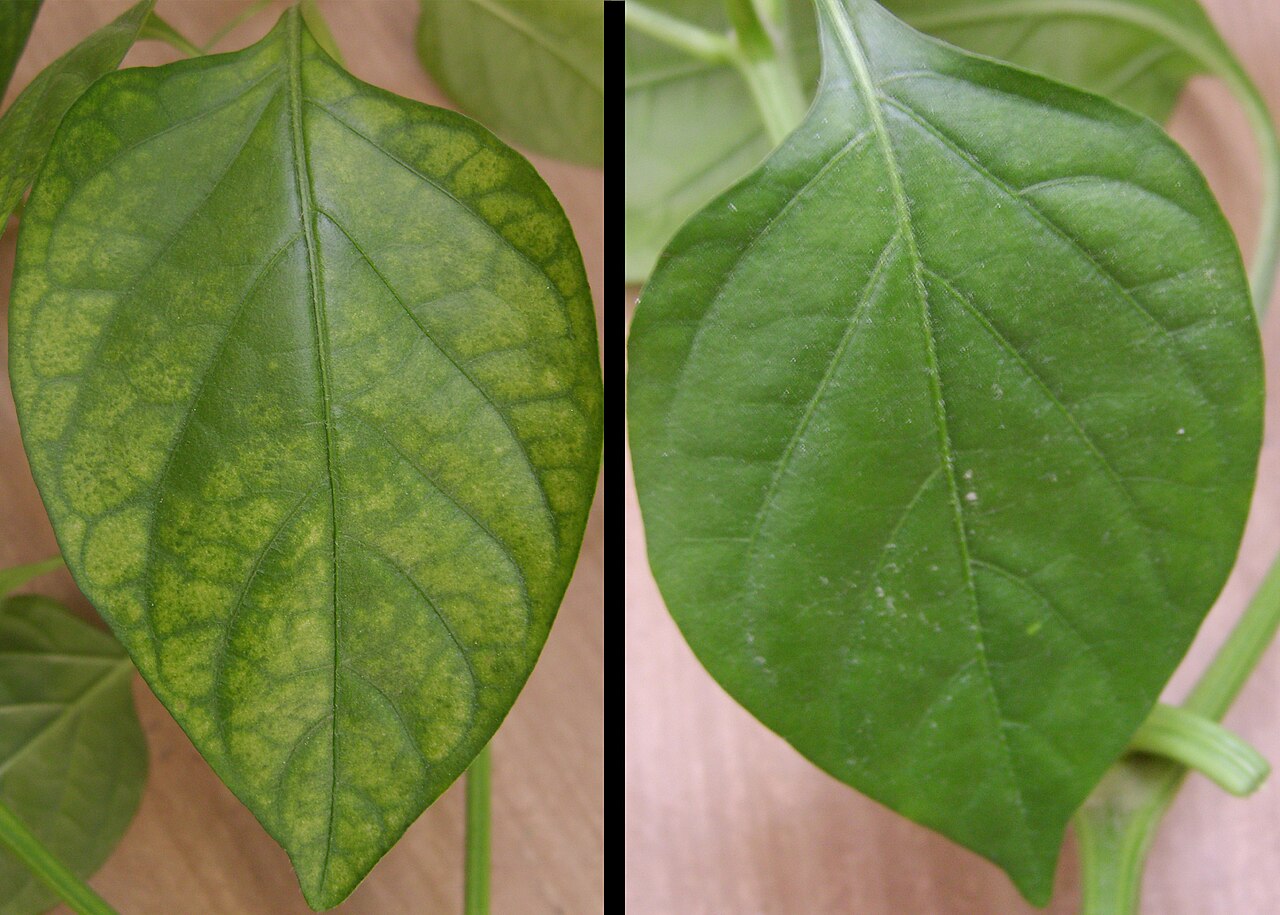
The photo shows the difference between a leaf starting to yellow and a healthy one. If you notice at the yellowing stage, before it browns, you can treat it sooner.
| What to check | Passing standard | If not | Source |
|---|---|---|---|
| Drafts | No direct air from AC or heaters | Move it out of the airflow | Hyponex |
| Humidity | Around 40 to 50%. Not below 20% in winter | Humidifier. Group pots together | Iowa State University |
| Watering | Once the soil is dry 3 cm down, water until it runs from the bottom | Do not leave it dry for too long | Iowa State University, Royal Horticultural Society |
| Saucer | No water left in it | Empty it | Clemson University |
| Soil surface | No white crust | Remove the crust and flush with water | Clemson University, University of Nebraska |
| Fertilizer | Spring to fall only, diluted as the label says. Stop in winter | Stop | University of Missouri |
| Roots | No roots coming out of the bottom | Repot | Hyponex |
| Water | Water left to stand, for sensitive plants | Rethink the type of water | Clemson University, Michigan State University |
With brown tips, the basic approach is "fix one thing at a time, then check the answer on the next leaf." If you change everything at once, you won't know what worked.
What Terms Come Up with Brown Houseplant Leaf Tips?
| Term | Meaning |
|---|---|
| Transpiration | Water leaving the leaf surface as water vapor |
| Leaf scorch | Death of leaf tissue when the water supply cannot keep up with transpiration, or from strong light |
| Fertilizer salts | Fertilizer components left in the soil that have hardened. They form a white to gray crust |
| Leaching (flushing salts) | Running water equal to twice the pot's volume through from the top to wash out fertilizer salts |
| Rootbound | A pot so full of roots that water has trouble soaking in |
| Misting | Spraying the leaves with water from a spray bottle. Helps remove dust and prevent spider mites |
| Relative humidity | The amount of water the air actually holds compared with the most it can hold, shown as a percentage |
| Fluoride | Found in tap water, some fertilizers, and perlite. Dracaena and some other plants are sensitive to it |
| Residual chlorine | Chlorine left in tap water to keep it disinfected |
Frequently Asked Questions About Brown Houseplant Leaf Tips
What should I do when leaf tips have died?
Trim only the brown part along the shape of the leaf, and fix the causes one at a time. Dead parts will not turn green again.
Check in this order. The goal is to keep the tips of the next leaves clean.
- Is air from an AC or heater hitting the plant?
- Has the soil stayed dry for a long time, or are roots coming out of the bottom of the pot?
- Are you giving too much fertilizer, or is there a white crust on the soil surface?
- In winter, has the room humidity dropped too low?
Why are the tips of the leaves turning brown?
Because the roots cannot keep up with the water leaving the leaves. The main reasons are dryness, underwatering, fertilizer salts, and being rootbound.
If the tips of many leaves brown in winter, suspect dryness, and if there is a white crust, suspect fertilizer salts. If the brown is in the middle of the leaf, also suspect overwatering.
Why are my pachira's leaf tips turning brown?
The causes for pachira are the same as for other plants: dryness, drafts, water, and fertilizer. Watch especially for direct air from AC or heaters.
Hyponex materials say to avoid places where AC or heater air blows directly. First move the pot out of the airflow, then look at how the soil dries.
You can see where the air flows by hanging a single tissue. Do not place pots where it sways.
How do you trim dead houseplant leaf tips?
Use clean scissors and cut only the brown part. Cutting at an angle to match the pointed leaf tip looks natural.
Do not cut into the green part. If most of the leaf is dead, cut the whole leaf off at the base.
Will dead leaf tips turn green again?
No. Once a part has browned and died, it will not turn green again, even with water or fertilizer.
Michigan State University materials also say dead parts do not recover. What to watch are the tips of the new leaves still to come. If the new leaves are clean, the cause has been fixed.
 Find by symptomWhy Houseplant Leaves Turn Yellow | Identify the Cause by Which Leaves Yellow First, Then Treat It by Plant and SeasonWhere yellowing starts narrows the cause. Covers Monstera, Pachira, Pothos, Ficus and Sansevieria, summer, winter and repotting, recovery odds and what to avoid.
 Find by symptomHow to Revive a Houseplant with Root Rot | Signs Before Unpotting, Root Color and Firmness, and Rescue by PlantHouseplant root rot can be reversed if white, firm roots remain. Signs before unpotting, root color, where to cut, soil and pot, rescue by plant, and a checklist.
 Care basicsHouseplant Soil Mix | Basic Ratios, What Each Ingredient Does, Mixes by Plant, and Indoor Soil That Resists Gnats and MoldA houseplant soil mix starts at 7 parts akadama to 3 parts leaf mold. Ratios by plant, indoor mixes that deter gnats and mold, bagged soil, and reusing old soil.TroubleshootingHouseplant Winter Temperatures | Minimums by Plant, When to Bring Them In, Cold Windows and Floors, Winter Watering and Insulation TipsOverwintering houseplants depends on whether night lows drop below each plant's minimum. Covers bringing them in, placement, watering, fertilizer, and insulation.
Sources
- Iowa State University Extension: Why does my houseplant have brown leaf tips and edges? (Low humidity, watering, fertilizer, water quality, sensitive plants, trimming tips)
- Iowa State University Extension: The air in our home is extremely dry in winter. Should I mist the houseplants? (Humidity 40 to 50%, 10 to 20% in winter, effect of misting)
- Penn State Extension: Humidity and Houseplants (Misting, pebble trays, humidifiers, grouping plants)
- RHS: Leaf damage on houseplants (Brown tips and edges from underwatering or overwatering, browning in the middle of the leaf)
- Missouri Botanical Garden: Scorch, Sunburn, and Heat Stress (How leaf scorch happens)
- Clemson University HGIC: Houseplant Diseases & Disorders (Brown tips and edges, salt crust, letting water stand 24 hours)
- Michigan State University Extension: Fluoride toxicity in plants irrigated with city water (Sources of fluoride, sensitive plants, pH)
- University of Missouri IPM: Houseplant Problems (Fluoride, softened water, fertilizing in winter)
- University of Nebraska-Lincoln Extension: Success With Houseplants - Fertilization (How much and how often to leach salts)
- KINCHO Engei Fertilizer Navi: Find It by Leaf Symptoms (in Japanese. Symptoms on old and new leaves, and nutrients)
- KINCHO Engei: Why Do Houseplants Die? 7 Causes, Symptoms, and How to Revive Them (in Japanese)
- Ministry of the Environment: Water Quality Standard Items and Values (52 items) (in Japanese. Fluoride and its compounds, 0.8 mg/L or less)
- Nagoya City: Maintenance of Private Waterworks (in Japanese. Free residual chlorine at the faucet, 0.1 mg/L or more, Waterworks Act Article 22)
- Hyponex Plantia: How to Grow Monstera (in Japanese. Misting)
- Hyponex Plantia: How to Grow Pachira (in Japanese. AC and heater drafts, misting)
- Hyponex Plantia: How to Grow Pothos (in Japanese)
- Hyponex: How to Grow Pothos and Growing Tips (in Japanese. Repotting interval)
- Hyponex Plantia: How to Grow Ficus Microcarpa (in Japanese. AC drafts)
- Hyponex Plantia: How to Grow Sansevieria, or Snake Plant (in Japanese)
- Hyponex Plantia: How to Grow Ficus Umbellata (in Japanese. Misting, AC drafts)
Read next
Find by symptomHP-01Why Houseplant Leaves Turn Yellow | Identify the Cause by Which Leaves Yellow First, Then Treat It by Plant and SeasonWhere yellowing starts narrows the cause. Covers Monstera, Pachira, Pothos, Ficus and Sansevieria, summer, winter and repotting, recovery odds and what to avoid.Find by symptomHP-03How to Revive a Houseplant with Root Rot | Signs Before Unpotting, Root Color and Firmness, and Rescue by PlantHouseplant root rot can be reversed if white, firm roots remain. Signs before unpotting, root color, where to cut, soil and pot, rescue by plant, and a checklist.